
1. What the benchmark measures
The Clout Quadrant compares brands on two channels. Search is unpaid visits from search engines such as Google and Bing. AI search is visits from AI platforms such as ChatGPT, Gemini and Copilot. Both count only traffic delivered to websites.
Data comes from Similarweb, using the same source, period and country filter for all brands in each chart.
2. How positions are calculated
Each chart compares a set number of brands, stated on the chart. Shares are calculated separately for search and AI search, using only the visits of the brands in that set.
Search share sets how far up a brand sits on the chart and AI search share how far to the right, so the further up or to the right a brand sits, the larger its share of that channel within the set.
The equal-share threshold is 100% divided by the number of brands compared (20% for five brands, 10% for ten). A brand is strong in a channel when its share equals or exceeds this threshold and weak when it does not.
- Leaders: strong in both channels.
- Latent Giants: strong in search, weak in AI search.
- Disruptors: strong in AI search, weak in search.
- Dark Horses: weak in both channels.
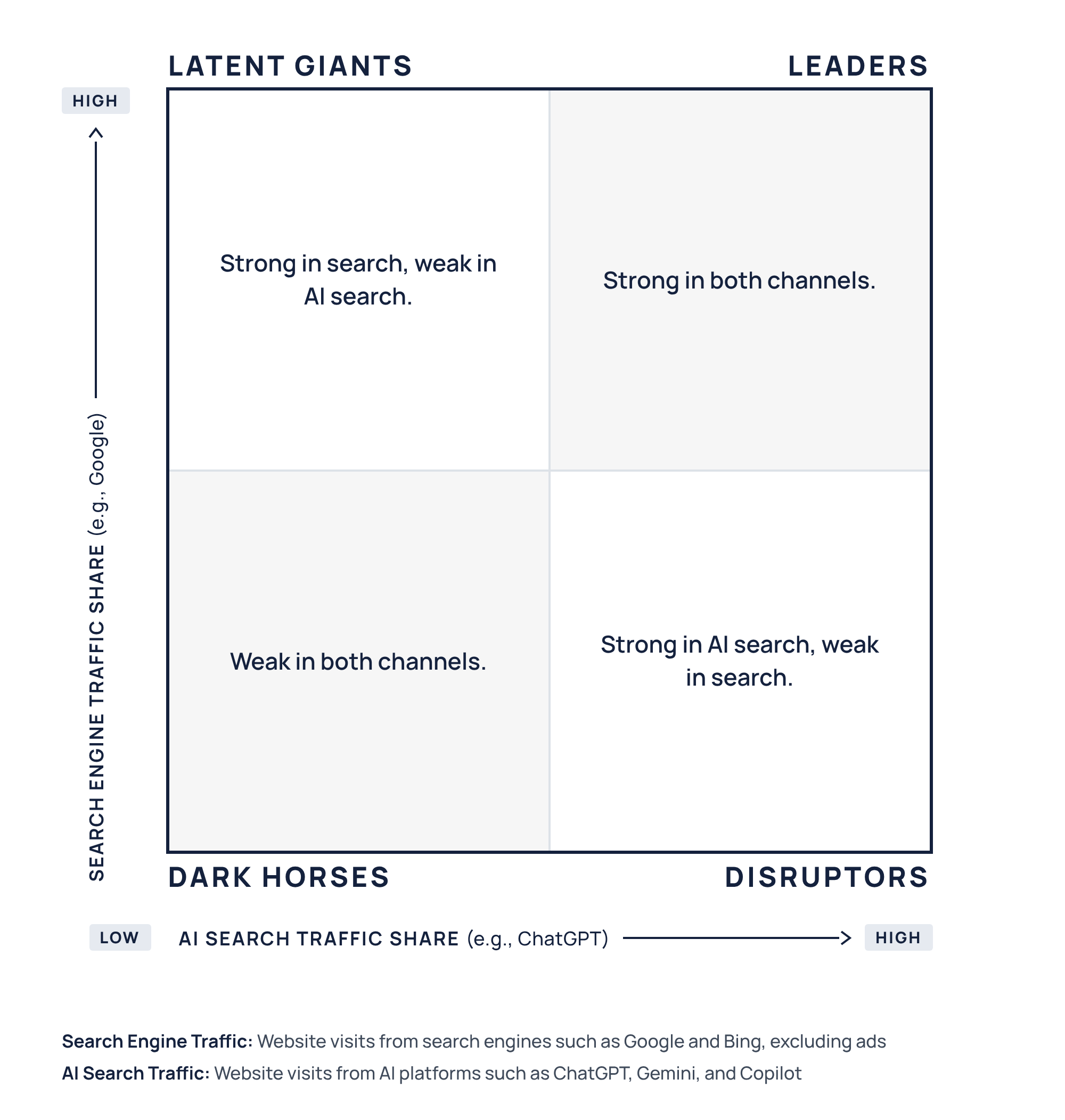
The axes are scaled so the equal-share threshold sits at the centre of the chart. Positions are relative to the selected brands, not the whole market. They are snapshots for the stated period and can change with the comparison set.
3. Brand selection and categories
Each category is an editorial selection informed by market prominence, search traffic and AI search traffic during the tracking period. These factors are considered in the context of each category’s competitive landscape and how its brands operate online, rather than through a single fixed formula.
The benchmark is not exhaustive. Absence implies no judgment on a brand’s performance or market standing. Once selected, brands’ positions are calculated from the data without editorial adjustment.
Categories group brands that consumers consider for similar purposes online, regardless of how those brands are licensed, classified or structured as businesses.
4. Domain scope
Each brand is measured using its main consumer-facing website at root-domain level. Services, sub-brands and features within that website are included in its traffic and are not benchmarked separately.
Brands owned by the same group can appear separately if each has its own standalone website. If a single brand has several websites, only its main consumer website is measured.
A website covering multiple business lines is measured as a whole and assigned to one category based on its primary search demand and consumer brand association. Its traffic is not split across categories.
5. Public edition and paid analysis
Each public edition is free and covers the brands shown at root-domain level. It provides a market benchmark, not individual brand advice. Brands not shown may request their position on the same measurement basis against the published set by emailing hello@cloutquadrant.com
Paid analysis is available for activity within a root domain, including product lines, subdomains, subsidiaries and embedded features, as well as brand mentions in AI answers, custom competitor sets, additional periods, other markets and channel-level diagnosis.
6. Limitations
Similarweb figures are estimates. The public benchmark measures website visits, not brand mentions in AI answers; a brand may be mentioned without receiving a visit. Mention-level visibility in AI answers is measured separately as paid analysis.
David Chong is the creator of Clout Quadrant™, a trademark of Content Clout Sdn. Bhd.